DSG transmission oil change costs: differences and key price factors
All the following information on costs and prices is provided as a guide and represents approximate ranges; it relates to the German market.
A DSG transmission oil change at a specialist workshop usually costs between €200 and €500, depending on the transmission type and the scope of work. The price range is mainly determined by the design of the dual-clutch transmission, the amount of oil required, the oil filter and the final adaptation procedure using the manufacturer’s diagnostic system. This guide breaks down the individual cost components, explains the main factors affecting the price and puts the figures into context for the VW Golf 7 and Škoda Octavia.
How much does a DSG transmission oil change cost?
In Germany, a DSG transmission oil change generally costs between €200 and €500. Independent specialist workshops often charge between €200 and €400, while prices of €500 or more are realistic at authorised dealerships and for more complex transmissions. The total cost comprises labour, transmission oil, the oil filter and seals, as well as any additional work required.
Cost breakdown at a glance
The total cost is divided into several items, which can account for different proportions of the overall price depending on the vehicle.
Oil change with or without a filter – price difference
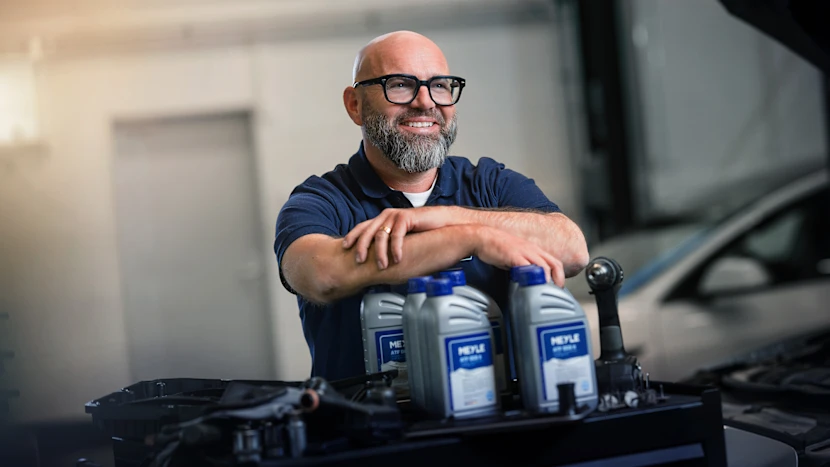
A full DSG service always includes the oil filter. For most DSG variants, replacing the filter is an integral part of the oil change. A standard oil change without a filter is cheaper, but technically incomplete, as the filter traps clutch wear particles. MEYLE oil change kits therefore contain not only the correct gearbox oil but also filters, seals and the necessary bolts.
What factors affect the cost?
The price range for a DSG transmission oil change is not arbitrary; it reflects several technical factors. The key considerations are the transmission design, the quantity and specification of the oil required, and the amount of work involved. These three factors account for most of the differences in cost.
DSG type: wet or dry clutch
The transmission design has a major influence on the work involved. Wet-clutch transmissions such as the DQ250 (six-speed) and DQ381 (seven-speed) operate with the clutches immersed in oil and require considerably more oil than the dry-clutch DQ200. In the DQ200, the oil lubricates only the mechatronics unit and the gears, so the quantity required and the resulting material costs are lower. The DQ200 also has a separate mechanical and hydraulic section. Accordingly, different lubricants are used in the respective sections.
Required oil quantity and specification
The required oil quantity varies considerably between transmissions. A DQ250 holds around 6–6.5 litres, while the DQ381 holds approximately 5.5–6 litres. The dry-clutch DQ200, by contrast, requires only around 1.7 litres for its hydraulic section. Only specially approved oil specified by the manufacturer may be used, for example oil meeting VW specifications G 052 182 or G 052 529 A2. A universal ATF is not approved for this application and can cause damage. MEYLE therefore supplies the appropriate transmission oil in accordance with the manufacturer’s specifications, ensuring that its viscosity, additives and properties are matched to the specific transmission.
Adaptation and diagnostics
After every DSG transmission oil change, an adaptation procedure using the manufacturer’s diagnostic system is required. During this process, the control unit relearns the friction characteristics of the system. Without this step, the transmission may judder during the first few kilometres. The diagnostic work involved is included in the labour charge.
How much does a DSG transmission oil change cost for the VW Golf 7 and Škoda Octavia?
For the VW Golf 7 and Škoda Octavia, costs generally range from €200 to €500, depending on the transmission fitted. Both models were available with different DSG variants, which explains the price differences. Smaller-engine versions often use the dry-clutch DQ200, while more powerful variants are fitted with the wet-clutch DQ250 or DQ381. A DQ381 transmission oil change, including oil, filter and adaptation, realistically costs around €350–€500. To identify the exact transmission, the transmission code associated with the vehicle identification number (VIN) is decisive.
How often should DSG transmission oil be changed?
Regular oil changes are necessary even for modern dual-clutch transmissions, so claims that they are filled for life should be treated with caution. MEYLE recommends changing the oil in automatic transmissions every 60,000–120,000 kilometres or every three years.
Regular changes are particularly important for wet-clutch transmissions to prevent deposits and damage. For wet-clutch transmissions such as the DQ250 and DQ381, manufacturers specify intervals towards the shorter end of this range. For the DQ381, VW specifies 60,000 kilometres or four years. Frequent short journeys, towing or sporty driving can cause the oil to deteriorate more quickly, making shorter intervals advisable. The vehicle manufacturer’s specifications must always be followed.
Transmission flush vs oil change: which is the right choice?
A conventional oil change replaces only part of the oil, whereas a flush replaces almost the entire volume. When the oil is simply drained, around 30% of the old oil, along with wear debris, remains in the system. A flush, by contrast, achieves a replacement rate of 90–95%. A flush is more thorough and therefore more expensive, but is particularly suitable for higher-mileage transmissions or where the oil is already contaminated. Ideally, the transmission oil should be changed every 60,000–120,000 kilometres to help prevent transmission damage. An individual assessment by a specialist workshop is advisable.
Why changing the oil on time pays off
Changing the oil on time helps prevent significantly higher follow-on costs. Degraded DSG transmission oil loses its lubricating and cooling properties, as well as the effectiveness of its additives. The result can be jerky gear changes, delayed responses and, in advanced cases, faults in the mechatronics unit. Repairs to the mechatronics unit or clutch packs can run into four figures. By comparison, a scheduled oil change is a relatively modest investment in maintaining the vehicle’s value. A documented service history for the transmission can also have a positive effect on resale value.
DSG transmission oil changes at a specialist workshop
A DSG transmission oil change should be carried out by a specialist workshop, as it requires specialist oil, manufacturer-specific diagnostics and filling at a controlled temperature. The workshop first reads the fault memory, changes the oil and filter, fills the transmission to the specified level at a defined oil temperature and then resets the adaptation values if required by the manufacturer. For automotive parts distributors and workshops, identifying the exact parts using the vehicle identification number (VIN) is essential to ensure that the correct oil, filter and seals are supplied.
This is where MEYLE oil change kits come in. They combine the appropriate transmission oil, filter, seals and the necessary bolts and drain and filling plugs in one complete kit, helping to make servicing more efficient. For related work on the drivetrain, MEYLE also offers precisely fitting components such as drive shafts, flex discs, wheel bearings and wheel hubs, as well as practical MEYLE KITs. These parts are manufactured with an OE-compliant fit in full accordance with MEYLE specifications and fit just like the original in every detail.
Frequently asked questions about DSG transmission oil changes (FAQ)
How much does a DSG transmission oil change cost at a workshop chain such as ATU? Prices at workshop chains and independent garages generally range from €200 to €400 for a DSG transmission oil change. The exact amount depends on the transmission type and the scope of work and can be determined through an individual enquiry.
How much oil does a DSG transmission require? Wet-clutch DSG transmissions require around 5–7 litres of specialist oil, whereas the dry-clutch DQ200 requires only around 1.7 litres. The exact quantity depends on the transmission.
Which oil can be used in a DSG transmission? Only oils that meet the specific oil specification approved by the manufacturer may be used.
Does the filter always have to be replaced during a DSG oil change? For most DSG variants, replacing the oil filter is an integral part of the service, as the filter captures clutch wear debris.
Why is adaptation necessary after an oil change? Fresh oil has different properties from degraded oil. Without adaptation using the manufacturer’s diagnostic system, the transmission may judder during the first few kilometres. However, adaptation is not always mandatory for every transmission variant, as many transmissions adapt automatically.
What happens if the DSG oil is not replaced? The oil deteriorates and loses its lubricating and cooling properties, contributing to shifting problems and damage to the mechatronics unit and clutches. Repairs are considerably more expensive than an oil change.
Summary
A DSG transmission oil change at a specialist workshop generally costs between €200 and €500. The main factors affecting the price are the transmission type (wet or dry clutch), the quantity of oil required and its approved specification, as well as the work involved in replacing the filter and carrying out adaptation. MEYLE recommends changing the oil in automatic transmissions every 60,000–120,000 kilometres or every three years, with wet-clutch transmissions such as the DQ250 and DQ381 generally towards the lower end of this range. Changing the oil on time helps prevent costly consequential damage, but the vehicle manufacturer’s specifications always take precedence.