


Flex disc
Flex disc (Hardy disc): function, importance and typical damage in the drivetrain
The flex disc is an essential connecting element in the drivetrain and plays a key role in power transmission, vibration damping and the durability of adjacent components. It forms the link between the transmission and the shaft, compensating for minimal movements, misalignments and torque peaks. Without it, strong vibrations, noise and material stress would impair both driving comfort and the service life of the entire drivetrain system. The flex disc is therefore one of the key components for smooth running, precise power transmission and the protection of all adjacent drivetrain parts – from transmission mounts to the cardan shaft.
What is a flex disc?
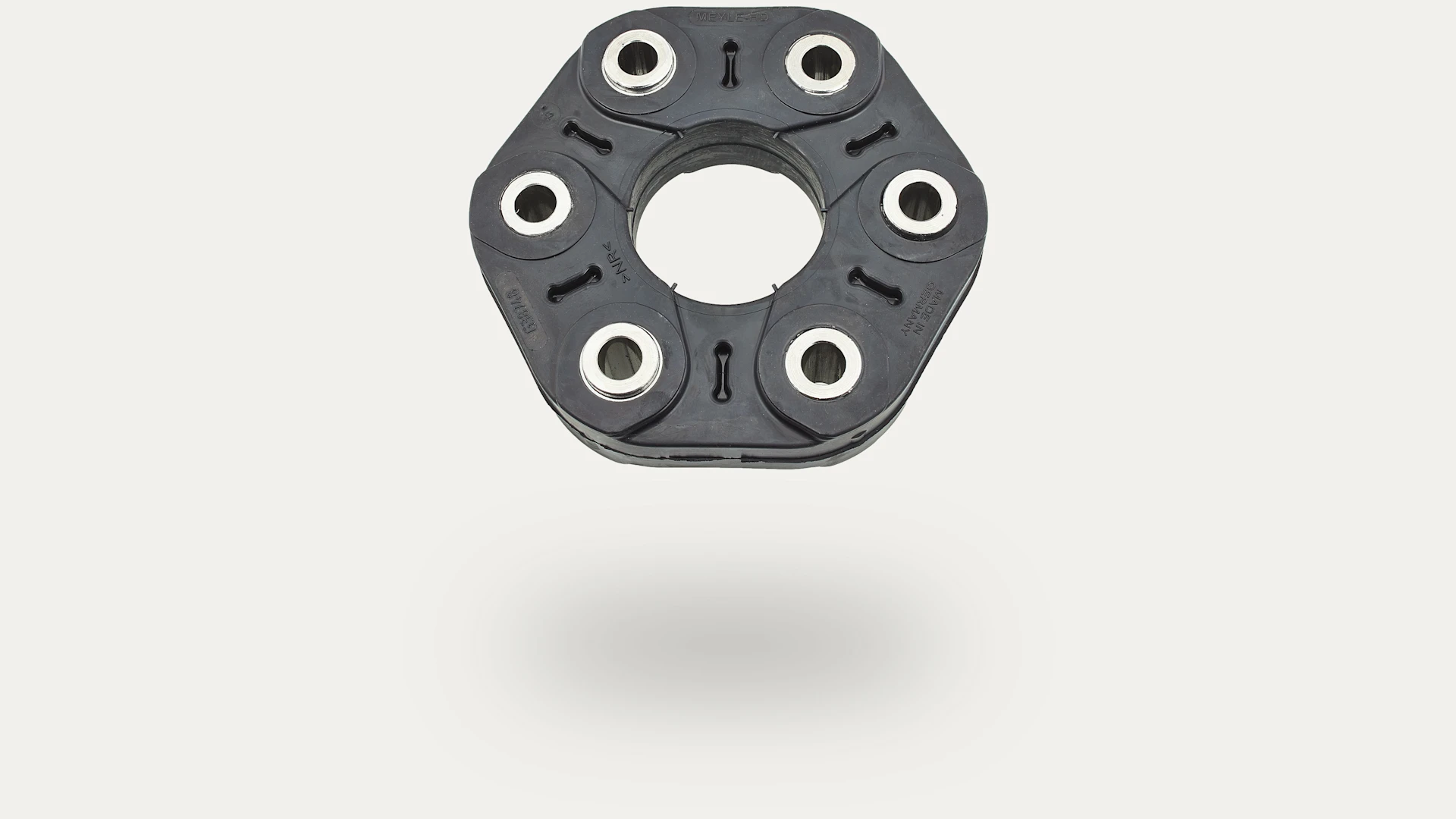
A flex disc, also sometimes known as a Hardy disc, is an elastic connection between two drive flanges. It transmits engine power while simultaneously compensating for movement and vibration within the drivetrain. This ensures reliable torque transmission, even if the engine and drive shaft are not perfectly aligned or move slightly relative to one another.
Connecting element between transmission and drive shaft
The flex disc is typically located between the transmission output and the cardan shaft or drive shaft. Several bolted connections secure the transmission and shaft flange pins within the metal bushings of the disc. The elastomer material in between absorbs dynamic loads, distributes them evenly and prevents abrupt torque peaks.
Unlike rigid couplings, a flex disc can flexibly accommodate movement, slight misalignment or changes in length without causing damage. This makes it a central component of the comfort and safety concept in modern drivetrain systems.
Material design: elastomer disc with metal inserts
The design of a flex disc is technically sophisticated. The rubber body consists of durable elastomers specifically engineered to withstand temperature fluctuations, ageing and exposure to media. Integrated metal elements and fabric reinforcements provide precise stability and guidance for the bolted connections. This combination of materials enables safe transmission of torque while simultaneously absorbing vibrations and noise. As such, material quality plays a decisive role in the overall service life of the drivetrain system.
Alternative name: Hardy disc
The term ‘Hardy disc’ originates from engineer John Leslie Hardy, who originally developed this elastic coupling for aircraft engines. Today, it is used in almost all passenger car and van drivetrains – whether as a flex disc in the drivetrain or in specialised versions for steering systems. Both terms refer to the same component, which performs a key function in ensuring low-vibration vehicle operation.
Function in the drivetrain and steering system
The flex disc ensures reliable torque transmission between drivetrain components while compensating for vibrations and movement. It contributes to smooth running, protects adjacent components and plays a key role in driving comfort.
Transmitting torque and damping vibrations
The elastomer absorbs torque peaks elastically and releases them in a controlled manner. This dampens vibrations that would otherwise propagate throughout the drivetrain. This damping reduces both acoustic effects – such as droning noises – and mechanical stress on bearings, joints and shafts. The flex disc is therefore not just a connecting element, but a precision component for vibration control.
Compensating for movement and length changes
During operation, the engine, transmission and shafts move slightly relative to each other due to torque shifts and elastic mountings. The flex disc compensates for these microscopic movements and changes in shaft length. At the same time, it maintains its shape and ensures centred power transmission. This protects the drivetrain from overload and compensates for manufacturing tolerances.
Improving smoothness and reducing noise
In combination with engine mounts, bearing brackets and centre bearings, the flex disc directly influences the vehicle’s NVH behaviour (noise, vibration, harshness). Its damping properties contribute to a smooth and consistent driving experience, particularly when pulling away, shifting gears or changing load. A properly functioning flex disc not only increases drivetrain durability, but also improves perceived interior comfort.
Design and materials
The quality of a flex disc largely depends on the selection and processing of its materials. Modern designs combine elastomers, metal bushings, fibre layers and reinforcement inserts in a precisely engineered configuration.
Elastomer compound, fabric reinforcement, bolt mounting
The elastomer compounds used must meet demanding requirements: they must retain their shape, remain elastic and maintain their properties even at extreme temperatures. The embedded metal bushings ensure precise guidance and long-term fixation of the bolted joints. Only when all components are perfectly matched – elastomer hardness, insert quality and press-fit dimensions – can the component deliver the required torsional strength and vibration damping throughout its entire service life.
Variants for drivetrain and steering systems
Flex discs are used in various areas of the vehicle. Versions for the drivetrain are designed to transmit high torque under variable loads, while versions used in steering systems must also enable precise feedback and linear control movements. The material composition and geometry are adapted accordingly. For example, the fibre content may be increased or the design height modified to ensure accurate angular movement.
Requirements for precision and torsional strength
Every flex disc must be manufactured within extremely tight tolerances. Even minimal deviations in Shore hardness or incorrect embedding of the bushings can lead to imbalance, vibrations or noise. Requirements for torsional strength, ageing resistance and dimensional accuracy are therefore critical. Only strictly controlled production processes and continuous quality checks ensure reliable performance under high thermal and mechanical loads.
Signs of a faulty flex disc
A defective flex disc rarely fails suddenly. In most cases, vehicle behaviour changes gradually. Early detection of typical symptoms can help prevent consequential damage.
Clicking or knocking during load changes
Audible clicking or noticeable knocking when switching between acceleration and deceleration usually indicates play in the connection. This play results from material fatigue or the bushings tearing out of the elastomer. If left unaddressed, wear can progress rapidly, overloading adjacent components such as universal joints or centre bearings and causing additional vibrations.
Vibrations in the drivetrain during acceleration
Typical symptoms include fine, speed-dependent vibrations that can be felt inside the vehicle. These result from imbalance and uneven power transmission. Delayed drivetrain response – noticeable as a slight ‘rebound’ when setting off – can also indicate deteriorating elastomer properties.
Cracks or damage in the rubber body
Clearly visible cracks or material breakouts in the rubber body are a clear warning sign. The flex disc should be inspected for damage during every service or when working on the shaft. Hairline cracks, porosity or breakouts indicate material fatigue and reduced damping performance.
Knocking when shifting gears
A harsh knocking noise during gear changes may occur if the elastomer has hardened significantly or if individual bushings have loosened. These noises are not only unpleasant but also indicate an impending failure.
Causes of flex disc wear
Flex discs are subject to significant stress during operation. In addition to constant torque transmission, temperature, time and environmental influences all play a role.
Torque loads and ageing rubber
During every journey, torsional forces stretch and compress the rubber material. Over time, this leads to ageing, hardening and loss of elasticity. Even if no visible damage is present, damping performance may already be reduced.
Environmental influences such as heat, oil or dirt
Oil vapours, road salt and high temperatures attack elastomers. They alter the chemical structure of the material, promoting cracks or delamination. Insufficient protection against moisture can also lead to corrosion of the metal bushings.
Imbalance in the drivetrain system, material fatigue
Incorrect alignment or imbalance in the cardan shaft places additional stress on the flex disc. Uneven running generates increased shear forces that weaken the rubber bond. Worn adjacent bearings can also introduce excessive forces, accelerating wear.
Consequences of a defective flex disc
A faulty connecting element in the drivetrain can have serious effects on comfort, driving behaviour and operational safety.
Play in the drivetrain and increased wear
Increased play in the drivetrain raises impact loads on universal joints, centre bearings and flange connections. Vibration damping decreases, causing wear to spread progressively to adjacent components.
Vibrations in the interior, reduced driving comfort
Typical symptoms include clearly noticeable vibrations during acceleration or load changes, as well as noise, particularly in lower gears. These vibrations not only reduce comfort but can also place long-term strain on interior components and drivetrain mounts.
Extreme case: damaged cardan shaft
If a defect is ignored, bolted connections may loosen or metal inserts may fail. In extreme cases, this can lead to damage to the cardan shaft – a safety-critical condition that must be avoided.
Quality and manufacturing reliability at MEYLE
MEYLE develops and manufactures flex discs with the highest precision and clearly defined quality standards to ensure durability, functional reliability and comfort.
MEYLE ORIGINAL flex discs are manufactured with an OE-compliant fit in full accordance with MEYLE specifications and fit just like the original in every detail. Strict development and testing processes in line with MEYLE standards, including precise functional testing, ensure consistently high quality – from the first component through to series production.
Heat-resistant elastomer compound for high torsional rigidity
The specially developed, heat-resistant rubber compound and reinforced design ensure high torsional rigidity and help minimise movement in the drivetrain while noticeably reducing vibrations. This combination provides a durable, resilient connection between transmission and drive shaft – even under high torque and temperature loads.
Variants for passenger cars and vans
The MEYLE portfolio includes a wide range of versions for passenger cars and vans. The design, Shore hardness and insert geometry vary depending on the application to ensure precise matching of torque characteristics and driving comfort to the respective vehicle class.
MEYLE HD – for maximum service life under high loads
For high-performance vehicles, MEYLE HD offers flex discs with a special heat-resistant rubber compound and reinforced design. They are true to OE in fit but technically refined and designed to withstand consistently high forces in the drivetrain – a robust solution for production vehicles that regularly deliver high torque and power to the road.
Quality and manufacturing reliability at MEYLE
MEYLE develops and manufactures flex discs with high precision and clearly defined quality standards to support durability, functional reliability and comfort. MEYLE ORIGINAL flex discs are manufactured with an OE-compliant fit in full accordance with MEYLE specifications and fit just like the original in every detail. Precision manufacturing, consistent vulcanisation and computer-controlled material processing ensure consistently high quality – from the first component through to series production.
Optimised elastomer compound for high torsional rigidity The specially formulated, heat-resistant rubber compound and reinforced design of MEYLE flex discs support high torsional rigidity. This reduces movement within the drivetrain and noticeably minimises vibrations. This provides a durable, resilient connection between transmission and drive shaft – even under high torque and temperature loads.
Variants for passenger cars and vans The MEYLE portfolio includes a wide range of versions for passenger cars and vans. Depending on the application, factors such as design, Shore hardness and insert geometry vary, allowing the flex discs to be precisely matched to different drivetrain concepts and vehicle classes. Workshops and automotive parts distributors can therefore find the right solution for a wide range of common applications.
MEYLE HD – for maximum service life under high loads For particularly demanding applications, MEYLE also offers MEYLE HD flex discs. They are true to OE in fit but technically refined and designed to withstand consistently high forces in the drivetrain. The specialised design reduces heat and friction, while the heat-resistant rubber compound withstands temperatures of up to 130 °C and enables torque transmission of up to 3,000 Nm. The high torsional rigidity of MEYLE HD flex discs helps minimise unwanted movement in the drivetrain and reduces vibrations and noise. MEYLE HD flex discs come with a four-year guarantee, making them a robust, long-lasting solution for vehicles that are regularly exposed to high loads.
Maintenance aspects in workshop environments
Although flex discs are designed to be maintenance-free, they should be checked as part of regular service work.
Visual inspection during service intervals and shaft work
A visual inspection during routine servicing, transmission work or repairs to the shaft allows any wear to be detected early. Any irregularities in bushings, cracks or elastomer surfaces should be documented and assessed.
Checking for cracks, axial play or misalignment
Inspections are usually carried out when the flex discs are removed, allowing better assessment of movement and material condition. Signs of cracking, separation or excessive play indicate material fatigue or incorrect load distribution.
Replacement only when clearly required – no preventive replacement
Replacement is recommended only when clear signs of damage or ageing are present. Routine replacement at fixed mileage intervals is not necessary. The key factor is a professional assessment.
Frequently asked questions (FAQ)
What is the difference between a Hardy disc and a flex disc? Both terms refer to the same elastic coupling element. ‘Flex disc’ is the modern technical term, while ‘Hardy disc’ reflects its historical origin.
What is the function of a flex disc in the drivetrain? It transmits torque between the transmission and shaft, compensates for movement and reduces vibrations. This protects the entire drivetrain.
What are typical fault symptoms? Knocking, vibration during load changes and acceleration, visible cracks or porous surfaces all indicate defects. Irregular torque transmission is also a warning sign.
What affects service life? Load intensity, material quality, environmental influences and the condition of adjacent components all directly impact durability. High-quality elastomers significantly extend the service life.
Why should workshops use tested branded parts? Only precisely manufactured and tested branded parts ensure accurate fit and consistent damping performance. This protects adjacent components and ensures reliable power transmission.
Summary
An intact flex disc is essential for smooth power transmission, drivetrain protection and driving comfort. Precision-engineered MEYLE flex discs – manufactured perfectly to MEYLE specifications with OE-accurate fit – combine technical precision, durability and comfort in a single component. This underlines MEYLE’s expertise in drivetrain technology – for reliable performance, safe driving dynamics and long-lasting smooth operation.