

Contact us
Questions, wishes, ideas?
We are happy to be there for you personally.
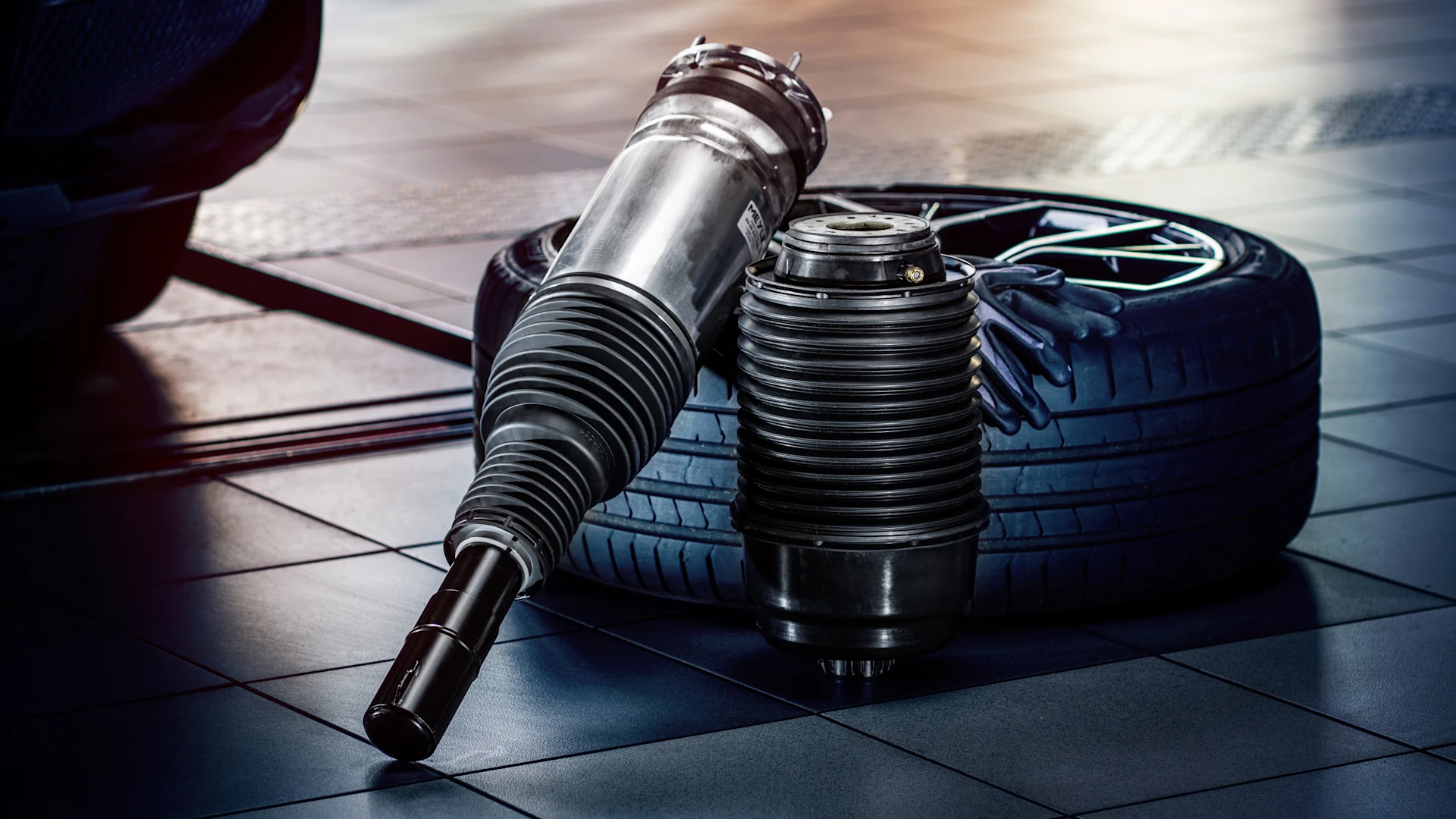
Air suspensions are no longer just a comfort option, but a central element of modern suspension systems in the premium segment. Because they ensure not only precise vehicle stability, but also adaptive driving comfort and efficiency. With the increasing age of vehicles and prevalence of this technology, the demand for spare parts in the independent aftermarket is also growing. Along with this, huge potential is opening up for workshops and wholesalers – provided that the parts fulfil the requirements in terms of quality, system integration and data availability.
The global market for air suspension systems was estimated to be worth approximately USD 12.63 billion in 2025 – by 2030 it should reach around USD 18.96 billion (CAGR ~8.5%)*. Drivers of this are their growing prevalence in the premium segments, more deeply integrated electronic controls and increasing demand from commercial vehicles and BEV platforms.
At the same time, the aftermarket share is also growing: while OEM solutions retain the largest share of turnover, the aftermarket for air suspension systems is growing at an estimated CAGR* of around 7.7%.
For a long time, air suspension was mainly OEM territory: high-quality, completely integrated systems were primarily available from vehicle manufacturers. Therefore, in the independent aftermarket, workshops were often faced with difficult choices – between expensive OEM parts and alternatives that could involve functional limitations, in terms of the tuning of damping systems or long-term leak tightness for example.
With the increasing prevalence of air suspension on premium and BEV platforms, this picture is changing. More and more vehicles with these systems are reaching an age where repairs make economic sense – and thus entering the independent aftermarket. In Europe, around 70% of all vehicles are older than four years, a segment that therefore accounts for the majority of IAM parts sales. The demand for OE-compatible aftermarket solutions that can be reliably integrated and meet the requirements of modern suspension systems is growing accordingly.
For workshops and wholesalers this means: air suspension is going from being an exception to being a relevant repair field – with growing demand, clear quality requirements and corresponding potential.
Air suspension systems combine mechanical components, pneumatic elements, sensors, electronics and the coordination of software. Differences in areas such as material quality, production processes and electronic compatibility can have a direct effect on system behaviour, functional depth and driving comfort.
For the IAM, this means: spare parts must not only function independently but also interact reliably within whole systems. Deciding factors are therefore:
OE-compatible specifications that correspond to the original functionalities
Tested sensors and electronic fine-tuning
Clear vehicle and parts identification
Air suspension is evolving from being a pure added comfort to being a central technology in modern premium vehicles – especially in high-end vehicle classes and on BEV platforms. For the independent aftermarket, this represents a growing segment with clear potential.
List of sources
* Mordor Intelligence. (2024). Automotive air suspension market – Growth, trends, forecast (2025–2030).
https://www.mordorintelligence.com/industry-reports/automotive-air-suspension-market
** ADIRA – Italian Association of Automotive Aftermarket Distributors and Repairers. (2024). European independent automotive aftermarket panorama.
https://www.adira.it/wp-content/uploads/2024/10/European-Independent-Automotive-Aftermarket-Panorama_final.pdf